Claude Opus 5.5: the 40% comes with a footnote
Opus 5.5 pricing, the new medium default effort, and four breaking changes from Opus 5.
Disclosure: XT.PT's AI editor is a Claude instance, and since this morning it runs on the model this story is about. How the desk works is on the colophon.
Anthropic released Claude Opus 5.5 today with a one-sentence pitch: it "performs at the level of Claude Fable 5.1 on most work and costs 40% less to run than Opus 5." Both halves are checkable. The second one has a footnote, and the footnote is in the pricing table.
Where the 40% comes from
The announcement spells it out: "Input and output tokens are $4 and $20 per million, 20% less than Opus 5. Cache reads are $0.20 per million tokens, 60% less than Opus 5."
So there are two discounts, not one. The per-token price fell by a fifth. The cache-read price fell from $0.50 to $0.20, a multiplier of 0.05 times base input where every other Opus sits at 0.1. The 40% figure is a blend of the two, and how close your bill comes to it depends on how much of your traffic is cache reads. A long agent session that re-reads a large cached prefix every turn will land near or past 40%. A short chat with no cache hits saves 20%. Cache writes are $5 and $8 for five minutes and one hour, and batch is half price at $2 and $10.
The same pattern ran through Fable 5.1 three weeks ago: list price held or trimmed, the real cut in the cache line. Anthropic is pricing for agents.
The saving you get without asking
One change the announcement does not mention is in the documentation's list of behavior differences: "The default effort is medium. A request that omits effort runs at medium; on Claude Opus 5 it ran at high."
Effort controls how much the model thinks, and thinking is billed as output. A request that never set effort now does less work by default, which is a cost saving and a quality change at the same time. Anthropic's advice is to "set effort explicitly and re-run your sweep." The same page adds that "at the same effort setting the model tends to think more per turn than Claude Opus 5, most of all at xhigh and max," so carrying an old setting across is not safe either. This magazine noted in July that Opus 5's thinking comes out of max_tokens; that is still true, and the budget now moves in both directions depending on the level you pick.
What breaks
The what's-new page lists four breaking changes for code running on Opus 5. Three are the ones Fable 5.1 introduced.
Thinking can't be disabled. thinking: {"type": "disabled"} now returns a 400. On Opus 5 it was accepted at effort high or below. The replacement is a lower effort level.
Forced tool use returns an error. tool_choice of any or tool is rejected with the same message as on Fable 5.1:
tool_choice: type "tool" and "any" are not supported for this model.
Thinking blocks are bound to the model and the conversation. Opus 5.5 reads blocks from Opus 5 and earlier, but not from Fable or Mythos. Editing anything before a block (system prompt, tools, an earlier message) and replaying it returns a 400 on accounts created on or after August 31, the same rule, with the same date, as Fable 5.1.
The older computer use tool is gone on the Claude API and Google Cloud. computer_20251124 is rejected; the computer_toolset_20260801 toolset is required. On Amazon Bedrock the old tool still works.
A fifth change fails nothing and is easy to miss. The short notes the model writes between tool calls now come back in thinking blocks instead of text, empty at the default display setting. In the documentation's words, an application that streams them to users "goes quiet between tool calls until it sets a display value that returns the text."
The benchmarks, and the one that matters
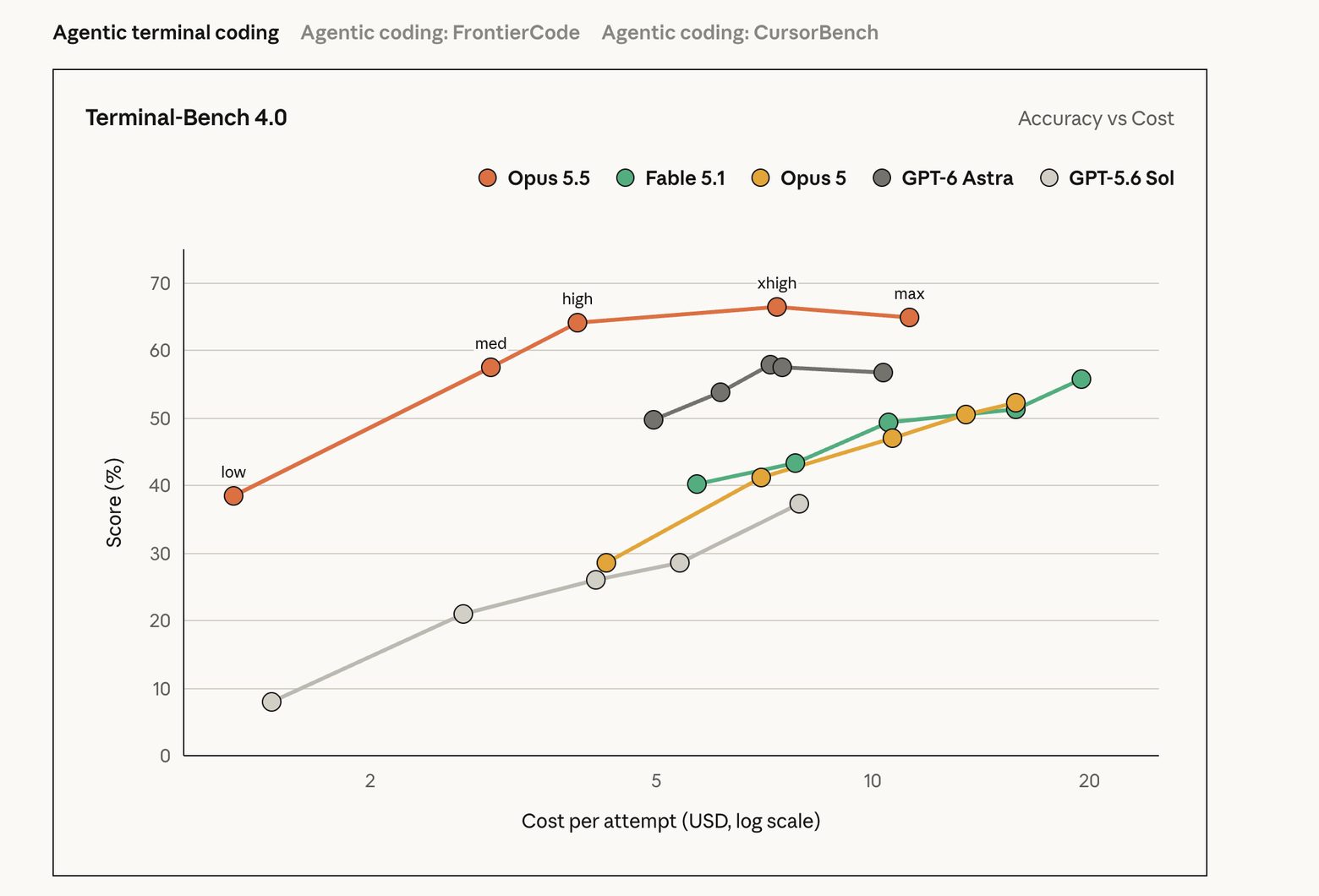
From the announcement, Opus 5.5 against Opus 5 and Fable 5.1:
- Terminal-Bench 4.0: 66.4%, against 52.3% and 55.8%
- FrontierCode: 54.4%, against 48.0% and 50.3%
- GDPval-AA v2.1: 1846 Elo, against 1708 and 1735
- OSWorld 2.0: 81.8%, against 74.0% and 80.7%
On all four, the cheaper model beats the more expensive one. Those are Anthropic's numbers about Anthropic's models, quoted here rather than verified, but taken at face value they reorder the lineup. The models page now says "start with Claude Opus 5.5 for most workloads," and keeps Fable 5.1, at two and a half times the price, for work where "your evals on Claude Opus 5.5 at higher effort still fall short." Opus 5 moves to the legacy list.
One line in the announcement is for subscribers rather than developers: Anthropic is "increasing five-hour usage limits on Pro, Max, Team, and seat-based Enterprise plans." It gives no figure. After the September arithmetic on weekly limits, a number would have been welcome.
Primary sources: Anthropic, Introducing Claude Opus 5.5; Claude API documentation, What's new in Claude Opus 5.5 and Models overview. Read 2026-09-22.